Churches have a life cycle. Too often, as congregants and leaders, we assume our church will be around forever. History tells a different story.
Christopher E. Sherwood makes this sobering observation in his doctoral thesis:
“Humanity has worked hard to enhance, extend, and enjoy life, but everyone knows death is inevitable. People tend not to think of churches this way, but they should. Churches around the world close every day. However, a misunderstanding exists regarding church life cycles, leading to what may be described as ‘zombie churches,’ which are alive on the outside but dead inside. These churches are terrible wasters of resources and a poor reflection of our glorious God.”
The phrase “zombie churches” may sound harsh, but Sherwood captures an uncomfortable reality. Most of us have seen these churches—and perhaps you are quietly wondering if your own congregation has become one.
Every human life follows a predictable pattern. We are born, grow through childhood and adolescence, reach maturity, experience decline, and eventually die. Churches and organizations tend to follow a similar cycle, often averaging around 80 years.
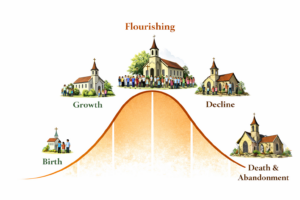
This is a typical church lifecycle curve.
You may disagree. You may know of churches that are 100 years old—or even older. And that is true. The primary reason a church can extend its life is that, at some point during decline, the downward trajectory is interrupted by a significant event. The church then experiences renewed growth, matures again, reaches another peak, and eventually enters decline once more.
Some churches experience this kind of renewal every 40 to 50 years. It may come through a season of revival, where many come to Christ, are baptized, and are discipled. At other times, it follows a leadership transition—a new pastor with vision and energy is called, and the congregation responds with renewed momentum. This cycle can occur once, twice, or even several times in a church’s history. As a result, the church that exists today may look nothing like the church that was planted more than a century ago.
Eventually, however, every church reaches a season of prolonged decline. Unless another interruption occurs, the church moves closer to the end of its life. This is not a failure. It is not a moral shortcoming. It is reality.
Churches close. That truth is neither bad nor wrong.
It is normal for churches to be planted, to flourish, to reach the height of their influence, and then to decline. What is unfortunate is how little support exists to help congregations and leaders navigate that final season with care, clarity, and faithfulness.
That is the gap we hope—however modestly—to help fill.
If this site encourages or challenges you, we would love to hear from you. And if you are facing difficult questions about your church’s future, we invite you to reach out. Schedule a complimentary conversation with Closing Churches Well. We would be honored to journey with you.