Churches Have a Life Cycle
Yet too often, as congregants and leaders, we live as though our church will be here forever. We make plans for next year, next decade, and even the next generation. We assume there will always be another pastor, another group of children, another Sunday morning, and another season of ministry.
History tells us something different.
Churches are born. They grow. They mature. They experience seasons of decline. And eventually, many of them die.
Christopher E. Sherwood makes this sobering observation in his doctoral thesis:
“Humanity has worked hard to enhance, extend, and enjoy life, but everyone knows death is inevitable. People tend not to think of churches this way, but they should. Churches around the world close every day. However, a misunderstanding exists regarding church life cycles, leading to what may be described as ‘zombie churches,’ which are alive on the outside but dead inside. These churches are terrible wasters of resources and a poor reflection of our glorious God.”
The phrase “zombie churches” may sound harsh. But Sherwood is pointing to something many of us have seen.
A church can remain open for years after its most fruitful season has passed. The doors are still open. The lights still come on. People still gather on Sunday morning. But the congregation may have lost its vitality, its influence, and its ability to fulfill the mission for which it was planted.
Perhaps you have seen a church like that.
Perhaps you are wondering if your own church has become one.
The Church Life Cycle
Every human life follows a recognizable pattern. We are born, we grow through childhood and adolescence, we reach maturity, we experience decline, and eventually we die.
Churches and other organizations tend to experience a similar pattern.
David Schoen, writing about church closure, observed that “the average lifespan of any church is about eighty years.” That should not be understood as a precise expiration date. Some churches are much older, and some are much younger. The point is that churches, like other organizations, have a life cycle.
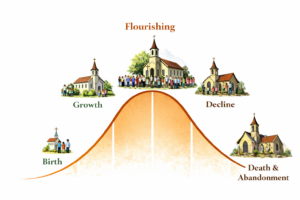
This is a typical church lifecycle curve.
The important question isn’t simply how old is your church?
The more important question is:
Where is your church in its life cycle?
A church may be decades old and still be experiencing renewed growth. Another may be much younger but already be well into a prolonged season of decline.
Age alone doesn’t tell the story.
What Interrupts the Cycle?
You may know of churches that are 100 years old—or even older. How did they make it that far?
Often, something interrupted the downward trajectory.
A church may experience a season of revival. People come to Christ, are baptized, and are discipled. New people become engaged in ministry. The congregation gains renewed energy and begins to grow again.
Sometimes the interruption comes through leadership.
A new pastor arrives with vision, energy, and a different way of seeing the congregation’s future. The church responds. Momentum returns. The congregation begins to grow and mature again.
In other words, the curve doesn’t always move steadily downward.
A church can decline, experience renewal, grow again, reach another peak, and eventually enter another season of decline.
Some churches experience this kind of renewal once. Others experience it several times over the course of their history.
That is one reason a church that is 100 or 150 years old may bear little resemblance to the church that was originally planted.
The name may be the same.
The building may be the same.
But the congregation, culture, leadership, community, and mission may have changed dramatically.
Eventually, Decline Comes
Eventually, however, every church reaches a season of prolonged decline.
Unless something interrupts that trajectory, the church continues moving toward the end of its organizational life.
This is where the conversation becomes difficult.
We tend to treat decline as though it must mean someone failed.
Perhaps the pastor failed.
Perhaps the leaders failed.
Perhaps the congregation failed.
Perhaps we simply didn’t pray hard enough, work hard enough, give enough, or try enough.
But what if that isn’t always the case?
What if decline is sometimes simply part of the life cycle?
Churches close.
That truth is neither bad nor wrong.
A church being planted is not bad.
A church flourishing is not bad.
A church reaching the height of its influence is not bad.
And a church eventually declining and closing is not necessarily bad either.
It is reality.
Finishing Well
The problem isn’t that churches have life cycles.
The problem is that we often don’t know what to do when a church enters the final stage of that cycle.
We have become much better at talking about church planting.
We know how to celebrate growth.
We have developed strategies for revitalization.
But we have far fewer conversations about what happens when revitalization is no longer realistic.
What does it mean for a church to finish well?
How do we help a congregation recognize when it has reached the end of its life?
How do we honor the people who spent decades serving that church?
How do we care for pastors and leaders who find themselves leading a congregation in decline?
How do we steward the building, finances, and other resources entrusted to the church?
And perhaps most importantly:
How do we help a church see its closing not as a failure, but as the final chapter of a life that mattered?
These are difficult questions.
But they are questions we need to ask.
Every church has a story.
Every church has a season of influence.
And every church leaves a legacy.
At Closing Churches Well, we believe the final season of a church’s life deserves the same care, intentionality, and faithfulness that we give to every other season.
Not every church will be revitalized.
But every church can finish well.
That is the gap we hope—however modestly—to help fill.
If you are wrestling with questions about where your church is in its life cycle, or what its next season might look like, we would be honored to be part of the conversation.